
Cherry Laurel (Prunus laurocerasus): UK Growing and Hedge Guide

Cherry laurel at a glance
| Cherry laurel | |
|---|---|
| Botanical name | Prunus laurocerasus (not related to bay, Laurus) |
| Leaves | Large, leathery, glossy, evergreen |
| Flowers and fruit | Upright spikes of small white flowers in spring to early summer, popular with pollinators, followed by small dark cherry-like fruit (RHS) |
| Size | From about 30 cm to around 5 m depending on variety (RHS) |
| Soil | Moist but well-drained, moderately fertile; waterlogging is a common cause of failure (RHS) |
| Light | Full sun or part shade; some varieties are particularly shade tolerant (RHS) |
| Growth | Often quoted by UK suppliers as 30–60 cm a year (indicative; the RHS gives no single figure) |
Source: RHS evergreen prunus guide unless stated.
Cherry laurel varieties
“Laurel” on a label usually means a hedging form of cherry laurel, but the species covers very different plants. These are the forms with RHS records:
| Variety | Typical size (RHS) | Use |
|---|---|---|
| ‘Rotundifolia’ | About 5 m | The usual hedging laurel |
| ‘Otto Luyken’ | 0.5–1 m tall, 1–1.5 m wide; RHS Award of Garden Merit | Low hedges, mass planting, under trees |
| ‘Mount Vernon’ | 0.1–0.5 m | Evergreen groundcover |
| ‘Castlewellan’ | 4–8 m; variegated leaves | Specimen shrub |
Nurseries also sell forms such as ‘Caucasica’ and ‘Etna’ for hedging; their published sizes and growth rates vary by supplier, so treat them as indicative.
Where cherry laurel grows well
The RHS says evergreen prunus thrive in moist but well-drained, moderately fertile soil with organic matter, in sun or part shade. Poor drainage is a common cause of failure, and long droughts can scorch the leaves on sunny or exposed sites. Its tolerance of shade is the main reason it is chosen over many other hedges for gloomy boundaries.
Planting a cherry laurel hedge
Container plants can go in at any time if you keep them watered. Root-balled and bare-root laurel is sold in the dormant season; nurseries such as Grasslands deliver root-balled stock in winter. Plant in a well-prepared trench with the root flare level with the soil, then mulch and water through the first summers.
| Plant size | Plants per metre (indicative) | Source |
|---|---|---|
| Bare-root whips | 4–5 | Grasslands |
| Small pots | 2–3 | Grasslands |
| 10–40 litre pots | About 2 | Grasslands |
| Large “instant” hedging | 1–1.5 | Grasslands |
| Pot-grown hedging | 3 (33 cm apart) | Ashridge Trees |
Worked example: a 12 m boundary
Counting from a plant at one end: at 50 cm spacing (about 2 per metre) you need 25 plants, with a first-to-last plant span of the full 12 m. At 33 cm you need 37; their first-to-last span is 11.88 m, leaving a 12 cm end margin. The hedge plant calculator works this out for any length.
Pruning cherry laurel
Cherry laurel responds well to pruning (RHS). The large leaves are the catch: a hedge trimmer cuts many in half and the cut edges turn brown. The RHS recommends secateurs or loppers on large-leaved hedges, cutting individual stems back inside the leaf canopy. Most hedges need cutting about twice in the growing season.
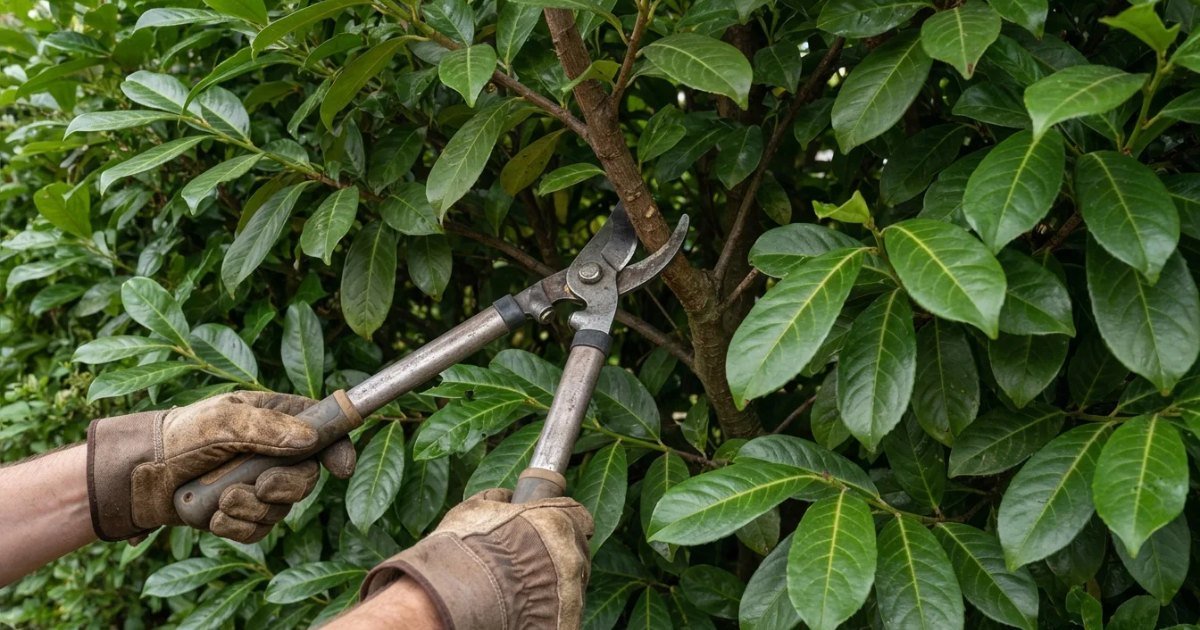
An overgrown laurel can be cut back hard in spring and usually regrows strongly; spread the work over two or three years if you need to keep some screening. Check for nesting birds before every cut: active nests are protected by law (RSPB guidance).
Wildlife and the environment
In a garden, cherry laurel has real wildlife value. The RHS notes its spring flowers attract a wide range of pollinators, and the dense evergreen cover shelters birds.

Outside gardens it is a different story. The GB Non-native Species Secretariat describes cherry laurel as non-native in England, Scotland and Wales, spreading in the shrub layer of woodland and casting dense shade that excludes other plants and can stop trees regenerating. A North Wales Wildlife Trust factsheet (2025) notes it is not currently listed in legislation as an invasive species. Legal status and ecological impact are separate questions: a plant can be legal to grow and still cause harm where it escapes.

- Avoid planting it right next to woodland or nature reserves.
- Never dump clippings over the fence or in the countryside.
- Pull out self-sown seedlings while they are small.
- On a wildlife-rich site, consider a mixed native hedge instead.
Is it poisonous? Children, pets and livestock
The RHS warns that many parts of evergreen Prunus, including the seeds and leaves, contain compounds that can release cyanide when damaged. It advises not eating the berries and not keeping trimmings in a confined space.
The evidence for animals comes from three different kinds of source, and it is worth keeping them apart:
- Genus-level listing: the ASPCA lists cherry (Prunus) as toxic to dogs, cats and horses, with cyanogenic glycosides as the toxic principle. This covers the genus, not cherry laurel specifically.
- Veterinary reference: PetMD describes laurel poisoning in horses and notes it can be fatal.
- Individual case: an Irish Veterinary Journal case report describes fatal cyanide poisoning in cattle that had been exposed to a laurel hedge.
The UK charity PDSA advises clearing up cut branches and leaves after hedge trimming.
- Teach children not to eat the berries.
- Clear up clippings straight away and dispose of them under your council’s garden waste rules; never leave them where horses, sheep or cattle can reach them.
- Don’t burn the trimmings or store large piles in a shed or garage.
- Wash hands after handling cut material.

Problems with cherry laurel
Holes, spots, yellowing and brown edges are common and usually not fatal. Our laurel leaf problems guide covers how to tell the causes apart. Still deciding between laurels? See cherry vs Portuguese laurel.
🌱 How fast does cherry laurel grow?
UK suppliers usually quote around 30–60 cm a year once established. The RHS gives no single figure, and growth depends on variety, soil and water.
🌱 Is cherry laurel poisonous to dogs?
Yes. The ASPCA lists cherry (Prunus) as toxic to dogs, cats and horses. Leaves and seeds can release cyanide when damaged (RHS).
🌱 Is cherry laurel invasive in the UK?
Ecologically, yes in woodland: it spreads in the shrub layer and its shade excludes native plants (GB Non-native Species Secretariat). A 2025 North Wales Wildlife Trust factsheet notes it is not listed in legislation as invasive. Keep it away from woodland edges.
🌱 Does cherry laurel grow in shade?
Yes. It grows in sun or part shade, and some varieties are particularly shade tolerant (RHS).
🌱 How tall does cherry laurel get?
From about 30 cm (‘Mount Vernon’) to around 5 m (‘Rotundifolia’) according to the RHS, and taller if never cut.
🌱 Can I compost laurel clippings?
Leaves are slow to break down. Many people use a council garden waste service; check what your council accepts. Never leave clippings where animals can eat them.
More laurel guides
Sources: RHS: Evergreen prunus · RHS: ‘Otto Luyken’ · RHS: ‘Mount Vernon’ · RHS: ‘Castlewellan’ · RHS: Pruning hedges · GB Non-native Species Secretariat · North Wales Wildlife Trust · ASPCA: Cherry · PetMD: Laurel poisoning in horses · Irish Veterinary Journal case report · PDSA: Poisonous plants · NHS: Poisoning · Grasslands (spacing) · Ashridge Trees (spacing)