
Portuguese Laurel (Prunus lusitanica): UK Growing Guide
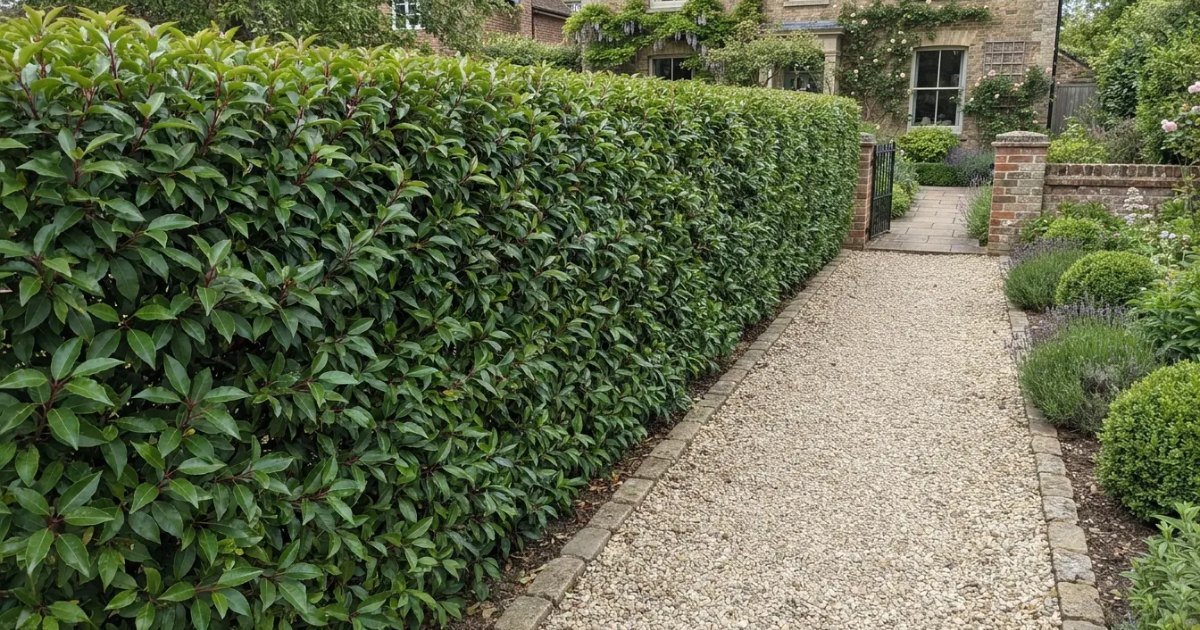
Portuguese laurel at a glance
| Portuguese laurel | |
|---|---|
| Botanical name | Prunus lusitanica (also called Portugal laurel) |
| Award | RHS Award of Garden Merit |
| Hardiness | H5 (RHS) |
| Leaves | Dark green, glossy, pointed, often on red young stems |
| Flowers and fruit | Fragrant white flower spikes in early summer, attractive to pollinators; small dark fruit (RHS) |
| Soil | Chalk, clay, loam or sand; thrives on poor, shallow, chalky soils (RHS) |
| Light | Full sun or part shade |
| Size if never cut | The species can exceed 12 m as a tree (RHS); hedges are kept far lower |
Source: RHS plant record and RHS evergreen prunus guide.
Why choose Portuguese laurel?
Most people pick it over cherry laurel for looks and soil. Its smaller leaves take clipping well, so it holds a sharp line and hides trimmer cuts better. The RHS rating for chalky soil also matters in much of southern England, where some hedges struggle. Gardeners’ World notes it grows well in most of the UK apart from very cold or exposed spots.
For a side-by-side look, see cherry vs Portuguese laurel.
Planting a Portuguese laurel hedge
Gardeners’ World suggests spacing plants about 60 cm apart, planting bare-root stock from November to March and pot-grown plants at any time, avoiding frozen ground. It also suggests buying UK-grown plants where possible, or checking the plant passport on imported stock, which records traceability rather than guaranteeing health.
Worked example: a 10 m hedge at 60 cm
Counting from a plant at one end, 17 plants give a first-to-last plant span of 9.6 m, leaving a 40 cm end margin; add one if you want a plant right at the end. Try other lengths in the hedge plant calculator.
Pruning and lollipop standards
The RHS places Portuguese laurel hedges in a pruning group trimmed in late spring or early summer. A light tidy later in summer keeps formal shapes crisp. As with any hedge, check for active nests first (RSPB).

The RHS notes that some forms, such as ‘Myrtifolia’ (4–8 m if left to grow), look good trained as a clear-trunked tree. Ready-trained standards are widely sold. In containers they need regular watering in summer and feeding, because compost runs out of nutrients. The same container basics as in our photinia in pots guide apply.
Other forms
The RHS also records ‘Variegata’, with cream-edged leaves, and ‘Angustifolia’, both rated H5.
Wildlife and plant health
The fragrant flowers are attractive to pollinators and the RHS lists Portuguese laurel among its Plants for Pollinators. Dense evergreen cover shelters birds through winter. The woodland-invasion concerns covered in our cherry laurel guide come from a GB assessment of cherry laurel; we did not find an equivalent assessment for Portuguese laurel.
Is it poisonous? Children, pets and livestock
The RHS warns that many parts of evergreen Prunus, including the seeds and leaves, contain compounds that can release cyanide when damaged. It advises not eating the berries and not keeping trimmings in a confined space.
The RHS guidance above covers both cherry and Portuguese laurel. We did not find veterinary data specific to Portuguese laurel; that describes the limits of our research, not evidence that it is safe. The animal evidence we found relates to cherry laurel and to Prunus in general (see our cherry laurel safety section), so treat Portuguese laurel with the same caution: keep clippings away from pets and grazing animals, and don’t burn them.
🌱 Does Portuguese laurel grow on chalk?
Yes. The RHS says it thrives on poor, shallow, chalky soils.
🌱 How far apart should I plant a Portuguese laurel hedge?
About 60 cm, according to Gardeners’ World. Closer planting fills in faster.
🌱 When should I trim Portuguese laurel?
Late spring or early summer (RHS), with a light tidy later in summer for formal shapes.
🌱 Is Portuguese laurel poisonous?
Treat it as poisonous. The RHS warns that seeds and leaves of evergreen prunus can release cyanide when damaged.
🌱 Is Portuguese laurel hardy?
The RHS rates it H5, but it can struggle in very cold or exposed spots.
More laurel guides
Sources: RHS: Prunus lusitanica · RHS: Evergreen prunus · RHS: ‘Myrtifolia’ · RHS: ‘Variegata’ · Gardeners’ World: Portuguese laurel hedge · RSPB: Birds’ nests