
Cherry Laurel vs Portuguese Laurel: Which Hedge Is Best? (UK)
Side by side
| Cherry laurel (Prunus laurocerasus) | Portuguese laurel (P. lusitanica) | |
|---|---|---|
| Leaves | Large, leathery, bright glossy green | Smaller, darker, pointed, on red-tinged stems |
| Character | Bold, fast screen | Neat and formal; holds a crisp line |
| Cutting | RHS: twice in the growing season | Suppliers suggest less often, as growth is slower |
| Planting gap (example) | Ask your supplier; varies with plant size | Gardeners’ World suggests about 60 cm |
| Plants for a 10 m run (single row) | Depends on spacing | 17 at 60 cm, planting both ends |
| Leaf diseases (RHS) | Powdery mildew, leaf spot, bacterial shothole | Most of the same, but not Eupropolella leaf spot |
| Award | RHS Award of Garden Merit |
Growth-speed comparisons come from hedging suppliers and are indicative. The RHS group guide describes both, but publishes no single growth figure for either.

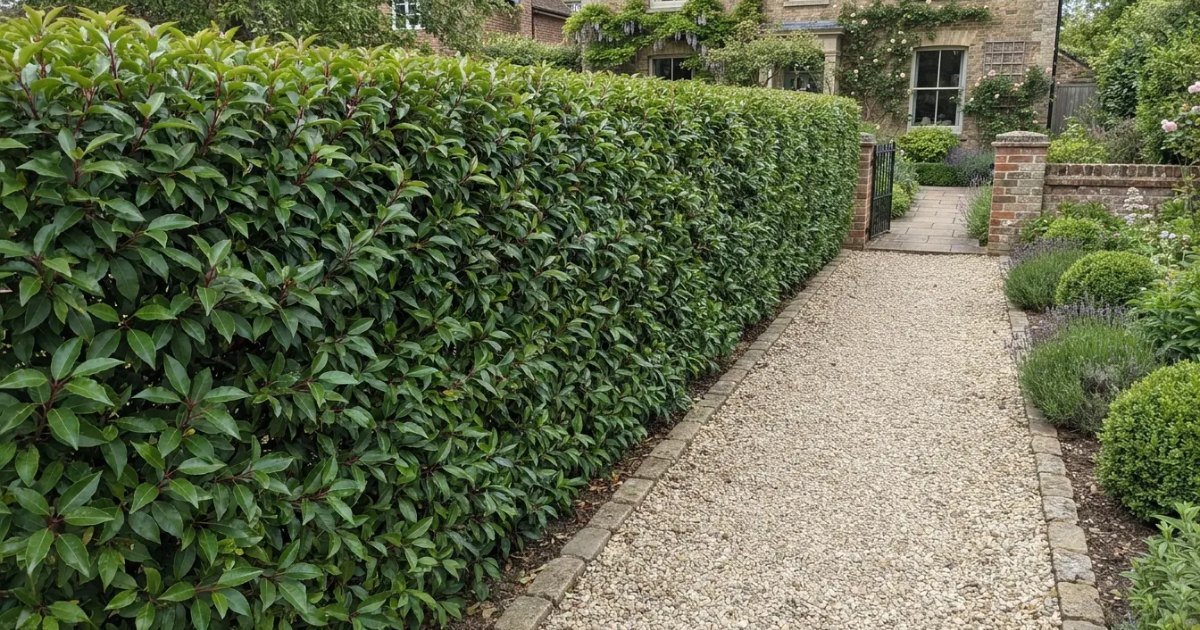
Which one for your garden?
Cherry laurel makes sense when…
Privacy is the priority and you can give it width. It is the classic quick screen. Also check the eventual size on the label: the RHS lists compact forms such as ‘Otto Luyken’ (about 1 m) and large hedging forms such as ‘Rotundifolia’ (about 5 m), and they are sold under the same “laurel” name.
Portuguese laurel makes sense when…
You want something that looks tailored, near a house or path, and you would rather cut less often. Gardeners’ World notes it grows well in most of the UK apart from very cold or exposed spots, and its denser foliage and tolerance of a wider range of soils make it a common favourite.
Planting and growing conditions
The RHS says both like moist but well-drained, moderately fertile soil with organic matter, in sun or part shade, and some forms tolerate quite shady spots. Waterlogging is a common cause of failure, and long droughts can scorch leaves in sunny, exposed places (RHS). Gardeners’ World advises planting bare-root stock from November to March and container plants at any time, avoiding frozen ground.
Cutting a laurel hedge without ruining the leaves
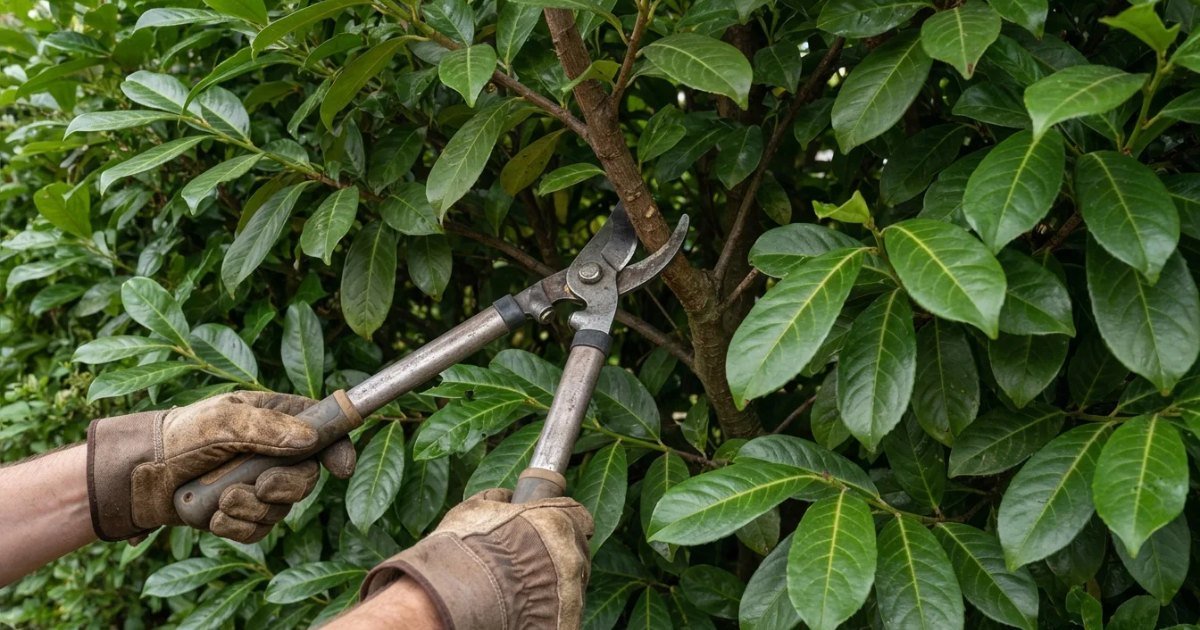
Big laurel leaves show every cut. The RHS recommends secateurs or loppers on large-leaved hedges, because shears and trimmers leave half-cut leaves that brown at the edges (RHS). Portuguese laurel’s smaller leaves hide trimmer cuts far better, which is part of why it suits a formal hedge.
Holes and spots in laurel leaves
| What you see | Likely cause (RHS) | What helps |
|---|---|---|
| Holes and ragged edges, sometimes white powder underneath | Powdery mildew; dead patches drop out and look like insect damage | Trim off the worst; avoid hard pruning |
| Brown spots whose centres fall out (“shot-hole”) | Leaf spot fungi | Same; plants often grow through it |
| Water-soaked spots with yellow halos, then holes | Bacterial shothole | No home-garden product controls it |
The RHS puts good growing conditions ahead of fungicides for laurel leaf diseases: it notes there is no specific evidence that home-garden fungicides work on laurel leaf spots, and none act against bacterial shothole. It also flags a disease not established in the UK (Xanthomonas) that has been intercepted on imported cherry laurel; report suspect new plants to the plant health authority.
Go deeper: our cherry laurel guide and Portuguese laurel guide cover each plant in full, including safety around pets and children, and laurel leaf problems explains holes, yellowing and brown leaves.
🌱 Which laurel grows faster?
Cherry laurel is generally the faster and bigger of the two, according to UK hedging suppliers. Portuguese laurel is slower and more compact.
🌱 Can I cut laurel with a hedge trimmer?
You can, but large cherry laurel leaves will show brown cut edges. The RHS suggests secateurs or loppers on large-leaved hedges.
🌱 Is laurel the same as bay?
No. Cherry and Portuguese laurels are Prunus. Bay (Laurus nobilis) is an unrelated plant (RHS).
🌱 Laurel or photinia?
Laurel is the tougher plain-green screen. Photinia ‘Red Robin’ adds red new growth but wants a more sheltered spot; see our photinia guide.
Planning the length? The hedge plant calculator works out plant numbers from your spacing.
Sources: RHS: Evergreen prunus · RHS: Prunus lusitanica · RHS: Pruning hedges · RHS: Laurel leaf diseases · Gardeners’ World: Portuguese laurel hedge