
Pruning Photinia Red Robin: When and How to Cut (UK)

When to prune photinia
The RHS says photinias need little pruning but benefit from an occasional trim in spring or summer to keep them dense and shapely. As a hedge, ‘Red Robin’ can be trimmed up to three times a year.
| When | What to do | Why |
|---|---|---|
| Spring (as growth starts) | Main trim: shorten shoots, take tips off young growth | Triggers the first flush of red leaves |
| Early summer | Second, lighter trim | Keeps the shape and brings a second flush of colour |
| Late summer, before mid-August | Optional final tidy | Regrowth has time to toughen before autumn frosts |
| Mid-August to winter | Avoid trimming | Soft new shoots are easily damaged by frost (RHS) |
| Spring (overgrown plants) | Renovation (hard pruning) | RHS advises renovating evergreens in spring |
The mid-August cut-off is horticultural guidance, not a rule written in stone. A small cut to clear a path in September will not kill the plant. A full trim then simply produces tender growth that cold weather is likely to brown.
How to prune for red leaves
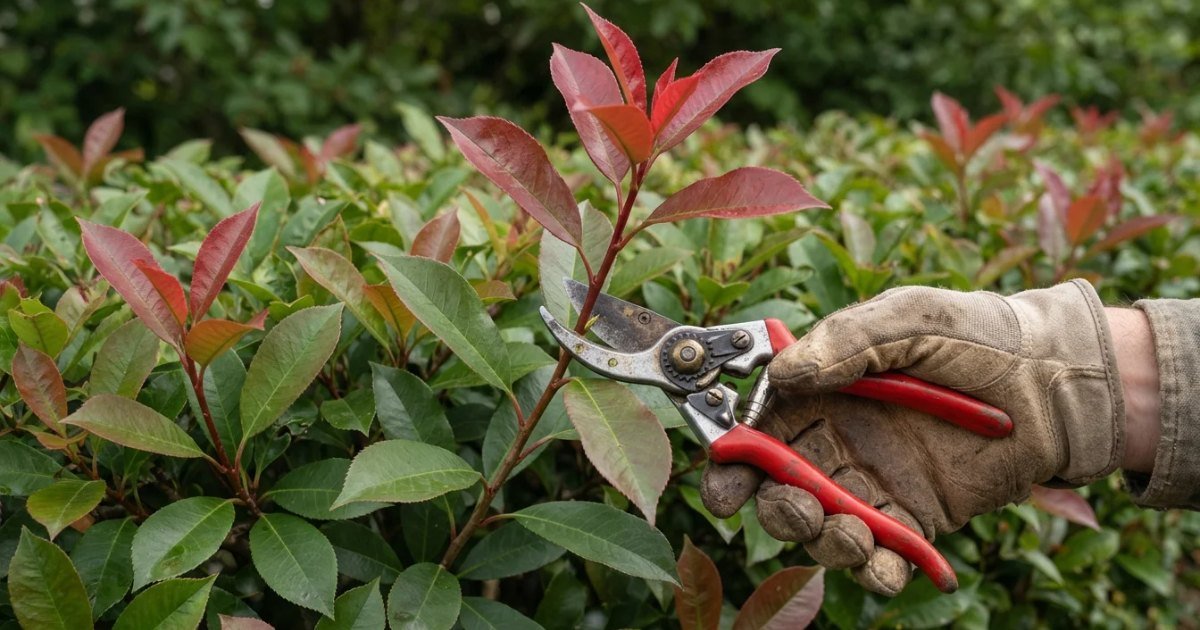
The red colour belongs to the new leaves, which turn green as they age. More fresh growth means more red. The RHS describes ‘Red Robin’ as vigorous, growing up to about 30 cm a year, and suggests shortening stems by up to 15 cm, cutting just above an outward-facing bud. On a hedge, removing the tips of young shoots encourages bright red regrowth.
The RHS prefers secateurs to a hedge trimmer because trimmers slice through leaves, leaving cut edges that brown. Secateurs are realistic on a few shrubs or a short hedge. On a long hedge most people use a trimmer and accept some damaged leaves, which are soon hidden by new growth.
Why is my photinia not turning red?
Usually one of three reasons. It hasn’t been cut for a while, so there is little new growth. It’s in too much shade, as the RHS says leaf colour is usually best in full sun. Or it’s simply late in the season and the spring leaves have matured to green. A light trim in spring or early summer, plus a sunnier position for future plantings, normally brings the colour back. Nurseries such as Grasslands also suggest a spring feed for a tired hedge.
Cutting back an overgrown photinia
Photinia responds well to hard pruning. For an overgrown plant the RHS suggests cutting back hard to a low framework, then thinning out congested shoots as they regrow. Renovate evergreens in spring (RHS).
If you are unsure how a plant will respond, or need to keep some screening, the RHS renovation guide suggests spreading the work over two or three years. With a hedge, a common approach is to cut one side and the top in the first spring and the other side the following year.

Feed and mulch in spring after renovation to support strong regrowth (RHS). Regrowth often comes through green before flushing red.
Thin and bare at the base or centre
If winter damage or leaf spot has left the plant sparse, the RHS suggests cutting back some stems in early May or June to encourage younger, leafier shoots. If leaf spot is the cause, cut in dry weather and clear up the fallen leaves. See our leaf spot guide.
Nesting birds and the law
Photinia is a dense evergreen, and the RHS notes that evergreen shrubs make useful nesting sites for birds in early spring. Under the Wildlife and Countryside Act 1981 it is an offence to intentionally take, damage or destroy the nest of any wild bird while it is in use or being built. That protection applies whenever a nest is active, not only between March and August. The details differ across the UK (in Scotland, reckless damage is also covered), and farm hedgerows have separate cutting rules. This guide covers garden hedges; check the RSPB guidance for your part of the UK.
The RSPB recommends avoiding hedge cutting between 1 March and 31 August, and checking thoroughly for active nests before any cut. That window overlaps the best time to prune photinia, so in practice: look carefully first, trim lightly, and leave any section with an active nest until the young have fledged.
🌱 When should I prune Photinia Red Robin?
Spring and early summer, with an optional light tidy in late summer. Avoid trimming after mid-August (RHS guidance).
🌱 How many times a year can I trim a photinia hedge?
Up to three times a year in the growing season, according to the RHS.
🌱 Can I cut photinia right back?
Yes. The RHS says an overgrown plant can be cut back hard to a low framework in spring. Spread it over two or three years if you want to keep some cover.
🌱 Should I use a hedge trimmer or secateurs?
The RHS prefers secateurs because trimmers cut through leaves. On a long hedge a trimmer is practical; damaged leaves are soon covered by new growth.
🌱 Why has my photinia gone green?
New leaves are red and mature to green. Too little pruning, too much shade or simply late season are the usual reasons.
More photinia guides
Sources: RHS: How to grow photinia · RHS: ‘Red Robin’ profile · RHS: Shrub renovation · RHS: Pruning evergreens · Wildlife and Countryside Act 1981, s.1 · RSPB: Hedge cutting advice · Grasslands Nursery (pruning)