
Grass Seed Calculator
Work out how much grass seed you need
Measure the area, pick new lawn or overseeding, and the tool gives you the weight in grams and kilograms, the number of packs, and the arithmetic behind it. The calculation runs in your browser; nothing is sent anywhere.
Your result
How this was worked out
What this calculation is. Area × rate, and nothing else. It does not know your seed mixture, your soil, how much of an overseeded lawn is actually bare, or how much seed the birds will take. It cannot tell you whether today is a sensible day to sow.
Rates vary more than people expect. Published UK supplier figures for a general-purpose new lawn run from about 35 to 50 g/m², and for overseeding from about 20 to 35 g/m². Pure browntop bent — a golf and bowling-green seed rather than a garden lawn mix — is sown far lower, at around 8–10. A fine fescue-and-bent lawn mixture is not sown at the bent rate. That spread is why this tool asks you for the rate rather than choosing one for you.
Affiliate links: As an Amazon Associate I earn from qualifying purchases. It costs you nothing extra.
Got your quantity? Order your seed
Prefer it delivered? Your local garden centre is the best place to compare bags in person — or order these online:
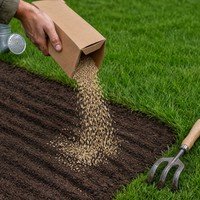 Miracle-Gro EverGreen Fast Grass Seed, 480 gQuick-germinating seed for new lawns and gapsView on Amazon →

Images are AI-generated illustrations, not photos of the exact product. Check the product, price and availability on Amazon.
Patching rather than seeding a whole lawn? Our guide to repairing bare patches covers how to work out why the patch went bare, and how to prepare it so the repair holds.
Why we ask you for the rate instead of choosing one
There is no single correct sowing rate for grass seed, and any tool that pretends otherwise is guessing on your behalf. The rate depends on the mixture: a hard-wearing ryegrass blend and a fine bent-rich lawn mix are sown at very different weights, because the seeds are different sizes and establish differently.
Published UK figures for a new lawn cluster around 35 g/m², with sources quoting up to 50 g/m² for hard-wearing family mixes. For overseeding an existing lawn the common figure is 25 g/m², with sources ranging from about 20 to 35. One rate sits far below all of these, and it is the one most often misapplied: pure browntop bent, sown at roughly 8–10 g/m². That is a golf-green and bowling-green seed with very fine seed, not a garden lawn mix. A fine fescue-and-bent lawn mixture is sown at ordinary lawn rates — Johnsons Luxury Lawn, a fescue and browntop blend, states 35 g/m². Do not use the bent rate for a fine lawn mix. The RHS, for its part, does not publish a single lawn rate at all: it says the weight per square metre is given on the packet, and for repairing bare patches suggests roughly 15–25 g/m², again at the rate the packet advises.
So: the examples in the tool are starting points drawn from that published range, and every one of them is editable. If your packet states a rate, use that. It was written by the people who know what is in the box.
New lawn and overseeding are different jobs
A new lawn is sown onto bare, prepared soil, and every seed has somewhere to land. Overseeding is sown into competition — existing grass, thatch, and whatever shade or wear thinned the lawn in the first place. That is why the published rates differ, and it is why the tool treats them as two modes rather than one number you remember to change.
For overseeding, measure only the part you are actually going to sow. If you have scattered bare patches, add up the patches rather than the whole lawn, or you will buy several times the seed you need. The calculator takes as many separate areas as you want to give it.
When to sow in the UK
The RHS points at autumn (September to November) or mid-spring (March to April), for a specific reason it states plainly: lawn seed germinates best when the soil is warm, there is plenty of moisture, and the weather is neither too cold nor too hot.
Take that as a description of conditions rather than a date in the diary. Those two windows are where UK conditions usually line up, but a calendar cannot see your garden. A cold, late spring in the north of Scotland and a mild March in Cornwall are not the same month in any useful sense. Waterlogged ground, a hard frost forecast, or soil still cold from a long winter will all beat the calendar. The practical question is whether the soil is moist, workable and warming — not what the date is.
Sowing it evenly — the trick that actually works
Weighing out the right amount does not help if two-thirds of it lands in one corner. The RHS method is simple and worth following: divide the seed into two equal batches. Sow the first half walking up and down the area in parallel rows, scattering as evenly as you can. Then sow the second half walking side to side, across the first pass. The two passes cancel out each other’s gaps.
What happens next
The RHS says seedlings typically appear a week to ten days after sowing, and advises using the lawn as little as possible for about eight months while it establishes. That last figure surprises people, and it is worth knowing before you sow a lawn the children are expecting to play on.
A worked example you can check yourself
A lawn 10 m by 8 m is 80 m².
- Overseeding at 25 g/m²: 80 × 25 = 2,000 g = 2 kg.
- New lawn at 35 g/m²: 80 × 35 = 2,800 g = 2.8 kg.
Same lawn, same tool, 800 g apart — which is why the rate is the input that matters most, and why it is worth reading the packet before you order.
What this calculator does not know
- Your seed mixture. It cannot tell a bent-rich fine lawn mix from a hard-wearing ryegrass blend, and those are sown at very different rates.
- How much of an overseeded lawn is genuinely bare. Only you can see that.
- Birds. Some of what you sow will be eaten. Netting or a covering is a judgement call, not a calculation.
- Whether today is a sensible day to sow. See above — that is about conditions, not arithmetic.
Sources used on this page
- RHS — Starting a lawn from seed (sowing windows and why; the two-pass sowing method; germination in 7–10 days; limiting use for about eight months)
- RHS — Repairing lawns: reseeding and returfing (roughly 15–25 g/m² for bare patches, at the rate advised on the packet)
- RHS — How to sow a wildflower patch (the principle that the weight per square metre is given on the packet and varies with the mix)
- The 35 g/m² new-lawn and 25 g/m² overseeding figures, and the ranges around them, were taken from several UK lawn-care and seed suppliers’ published guidance compared against each other — not from any one seller. They are presented here as a range precisely because the sources disagree. Johnsons Luxury Lawn, a fescue and browntop lawn mix, states 35 g/m².
- The pure browntop bent rates come from the seed suppliers’ own product pages: Rigby Taylor R105 (8 g/m² sowing, 4 overseeding), Goldcrop (8–10 sowing, 4–6 overseeding) and Grass Seed Online (10 sowing, 5 overseeding). Those are greens-type surfaces, not garden lawns.
How this page was checked
The RHS figures above were read from the pages linked in October 2026 and are quoted rather than rounded. Where the RHS does not give a figure — and for whole-lawn sowing rates it does not — this page says so instead of borrowing a number and attributing it to them.
The calculator’s arithmetic was checked against examples worked out independently of the tool, including the 80 m² case above at both 25 and 35 g/m².
We are not horticulturists and do not claim to be. This page turns measurements into a weight, shows the arithmetic, and is honest about where the rate comes from and how much it varies. If you find an error, tell us and we will correct it and say so.