
Mulch and Compost Calculator
Work out how much mulch or compost you need
Add every area you want to cover, set the depth, and the tool shows the volume in litres and cubic metres, the number of bags, and the arithmetic behind it. Nothing is sent anywhere — the calculation runs in your browser.
Your result
How this was worked out
What this calculation does and does not include. It is area × depth, nothing more. It does not allow for mulch settling or being walked on, for an irregular edge, for material lost in handling, or for how loosely a product is packed in its bag. Add an allowance above if you want headroom.
No weight conversion. This tool gives volume only. Turning cubic metres into kilos or tonnes needs the density of the particular material, which varies with what it is made of and how wet it is, so we do not guess at it. If you are buying by weight, ask the supplier what volume their tonne covers.
Affiliate links: As an Amazon Associate I earn from qualifying purchases. It costs you nothing extra.
Got your quantity? Order your mulch
Prefer it delivered? Your local garden centre is the best place to compare bags in person — or order these online:
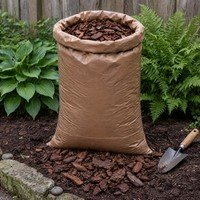
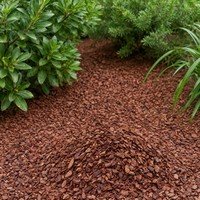
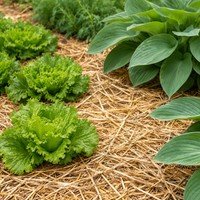
Images are AI-generated illustrations, not photos of the exact product. Check the product, price and availability on Amazon.
Doing the job as well as costing it? Our step-by-step guide to mulching an existing border covers when the soil is right, what to weed first, and how far back to keep mulch from stems.
How to measure a bed or border
Most gardens are not made of neat rectangles, and you do not need them to be. Pace or tape the longest straight run you can, then the width at its widest and its narrowest, and use the average of the two. If a bed bends round a corner, treat it as two shapes and add both to the calculator. A curved end is close enough to half a circle for this purpose.
Measure the soil you are actually covering, not the whole bed outline. If a third of the border is taken up by a shrub skirt or a path edge, take that off. The calculator will happily total a dozen separate areas, so splitting an awkward shape up costs you nothing and is more accurate than one rough guess.
How deep should the mulch be?
Depth is the figure that moves the answer most, and it is the one people most often guess at. For a border mulch of composted organic matter, the RHS says the layer should be at least 5 cm (2 in) deep, and ideally 7.5 cm (3 in). Chipped or shredded wood is the exception — the RHS says it can be applied deeper than a traditional composted mulch, at roughly 8–12 cm (3–5 in).
Two cautions that come with that advice and are easy to lose. The RHS says to take care not to smother low-growing plants, and to keep mulch from piling against the stems of woody plants — it gives a mulch-free circle of about 10 cm (4 in) around woody stems. And you do not have to do the whole garden at once: its own suggestion is to mulch about a quarter of your beds and borders each spring.
On timing, RHS guidance varies by page rather than giving one date. One describes mulch going on from late autumn to late winter; the border guide points at late winter or early spring. Either way the practical condition matters more than the month — mulch goes onto soil that is already moist and not frozen, because a mulch holds in whatever moisture is underneath it rather than adding any.
Filling a raised bed is a different job
The calculator will work out the volume for a raised bed, and the arithmetic is identical — area times depth. There are deliberately no raised-bed depth presets: a preset reads as a recommendation however it is labelled, and no published guidance decides how deep you should fill. Enter the depth you still need to fill — measure down from the top of the bed to whatever is already in there, not the full height of the sides. A 450 mm bed already holding 150 mm of last year’s compost needs 300 mm, not 450.
The material is different too. A mulch sits on top of existing soil and is chosen to break down into it. A raised bed needs something plants can root through for the whole season, which usually means topsoil or a soil-and-compost blend rather than a bark mulch. If you are doing both jobs, calculate them separately.
Bags, bulk bags, and why we ask you for the volume
Bagged compost and mulch are sold by volume in litres, and the figure is printed on the bag — 40, 50, 60 and 75 litre bags are all common. Put the figure from the bag you intend to buy into the calculator rather than trusting a default, because the bag count is only as good as that number. One cubic metre is 1,000 litres.
A “bulk bag” has no standard size at all, which is why this tool will not assume one for you. Published volumes from UK suppliers for a single bulk bag run from about 0.5 m³ to 1 m³, and some sellers say plainly that not all bulk bags are the same and that the stated litres vary with the product inside. Find your supplier’s stated volume for the specific product, then enter it.
You will also notice this tool gives you no weight. Converting cubic metres into kilos or tonnes needs the density of the particular material, and that changes with what it is made of and how wet it is on the day. We would rather give you no figure than a confidently wrong one. If a supplier sells by the tonne, ask them what volume a tonne of that product covers.
What the answer does not account for
- Settling and compaction. A loose mulch drops as it weathers and as you walk on the bed. The calculated depth is the depth on the day you spread it.
- How loosely the product is packed. Two 50 litre bags of different materials do not necessarily spread the same distance.
- Irregular edges and losses in handling. Some of every barrow-load ends up on the path.
- Whether the depth is right for the plants. The arithmetic cannot tell you that a bed of alpines or low ground cover wants less than a shrub border.
That is what the optional allowance is for, and why it is shown on its own line rather than folded quietly into the measured figure. If you want the bare measurement, leave it at zero.
A worked example you can check yourself
A border 8 m long and 1.25 m wide is 10 m². At the RHS ideal of 75 mm, that is 10 × 0.075 = 0.75 m³, or 750 litres. In 50 litre bags: 750 ÷ 50 = 15 bags exactly. Drop the depth to the 50 mm minimum and the same border needs 0.5 m³ — 500 litres, or ten bags. The depth changed by 25 mm and the order changed by a third.
Sources used on this page
- RHS — How to mulch with organic matter (border depth, mulch-free circle around woody stems)
- RHS — Mulches and mulching (what a mulch does, how much to do in a season)
- RHS — Woody waste: using as mulch (the deeper range for chipped wood)
- RHS — How to create a garden border (timing)
- Bulk-bag volumes compared across UK suppliers’ own stated figures, including Field Compost (approx. 1 m³ standard bag, 0.73 m³ dumpy bag) and Earthcycle (which states that not all bulk bags are the same).
How this page was checked
The depth figures above were taken from the RHS pages linked, read in October 2026, and are quoted rather than rounded or re-interpreted. The calculator’s arithmetic was checked against worked examples computed independently of the tool, including the 10 m² case above. The bulk-bag range was taken from suppliers’ own published volumes, not from a single source.
We are not horticulturists and this page does not claim otherwise. What it does is one narrow job carefully: turn measurements into a volume, show the arithmetic, and point at the published guidance behind the depths it suggests. If you spot an error, tell us and we will correct it and say so.