
Turf Calculator
Work out how much turf you need
Measure the lawn, take off anything that is not getting turfed, add a cutting allowance, and the tool gives you whole rolls and the area you will actually have bought. The calculation runs in your browser; nothing is sent anywhere.
Your result
How this was worked out
What this does not account for. How your lawn's shape falls against the roll width — a long thin lawn wastes more than a square one of the same area. Whether offcuts are usable. Access, delivery minimums, or a supplier's own pallet quantities.
Order for one delivery. Turf is a living product with a short shelf life, so it is normally laid within a day or two of arriving. Running short and ordering a second batch days later can mean a visible difference in colour and growth, which is the real reason the cutting allowance is worth having.
Affiliate links: As an Amazon Associate I earn from qualifying purchases. It costs you nothing extra.
Feed to help new turf take
Buy turf from a local supplier so it is fresh on the day. For the lawn feed to go with it:
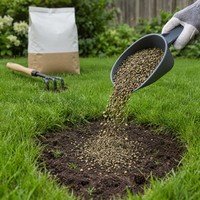
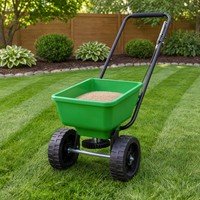
Images are AI-generated illustrations, not photos of the exact product. Check the product, price and availability on Amazon.
Measure once, then take things out
The quickest reliable way to measure an awkward lawn is to pretend it is a simple shape, measure that, and then subtract everything inside it that is not getting turfed: the path across the middle, the island bed, the pond, the tree pit, the patio corner.
That is less fiddly than trying to measure the remaining jigsaw directly, and it is harder to get wrong. The calculator takes as many added and subtracted areas as you want to give it, and shows each one separately in the working so you can check what went where.
Why the cutting allowance matters more for turf than for most materials
Turf comes in fixed-size rolls, and you cannot put an offcut back. Every curve, every edge, every awkward corner costs you a piece that will not fit anywhere else. UK turf suppliers commonly suggest adding somewhere around 5–10% to the measured area, and the shape of your lawn decides where in that range you should be: a plain rectangle wastes very little, a kidney-shaped lawn with three island beds wastes a lot.
There is a second reason, and it is the one people discover the hard way. Turf is a living product with a short shelf life, so it is normally laid within a day or two of delivery. If you run short and order a second batch later, it may have been cut on a different day from a different part of the field — and the join can stay visible. It is better to have a square metre spare than to be a square metre short.
The allowance is shown as its own line in the result, never folded into the measured figure, so you can always see what you actually measured and what you added on top.
How much does one roll cover?
Most mainstream UK lawn turf is sold as roughly one square metre per roll. Several large suppliers state dimensions in the region of 1.6–1.7 m long by about 0.6 m wide, which comes out at about 1 m² a roll.
But that is a trade convention, not a rule, and this tool deliberately does not assume it. Some products are cut differently, and specialist products — wildflower turf, for instance — can come in quite different sizes. The roll size is printed on every supplier’s product page, and entering their figure takes five seconds. If you only have the dimensions, the calculator will work the area out from the length and width for you.
Rolls are also heavy — commonly quoted at around 15–20 kg each depending on how wet they are — which is worth knowing before a pallet arrives at the end of a long driveway.
A worked example you can check yourself
A lawn of 40 m² with a 10% cutting allowance:
- 40 × 1.10 = 44 m² to order.
- At 1 m² per roll: 44 ÷ 1 = 44 rolls.
- At 0.8 m² per roll: 44 ÷ 0.8 = 55 rolls.
Eleven rolls of difference on the same lawn, purely from the roll size — which is exactly why the tool asks you for it rather than picking a number.
Natural turf only
This calculator is for real grass sold in rolls. Artificial grass is a different product sold from wide rolls of sheet, and laying it involves planning seams and cutting directions rather than counting turves. Using these numbers to order artificial grass would give you the wrong answer, so we have kept the tool to one job and said so plainly.
What the answer does not account for
- The shape of your lawn against the roll width. A long thin strip wastes more than a square of the same area. The allowance is a blunt instrument for a problem that depends on geometry.
- Whether offcuts are usable. Sometimes a trimmed piece fills the next gap; often it does not.
- Supplier minimums and pallet quantities. Some suppliers sell in fixed pallet sizes, which may round your order up again.
- Ground preparation. Turf needs a prepared, levelled, firmed bed underneath it. That is a separate job, and this is a quantity calculator, not a laying guide.
Sources used on this page
- Roll dimensions and coverage were compared across several UK turf suppliers’ own published product information, including Rolawn (approx. 610 mm × 1640 mm), Online Turf, George Davies Turf (1.65 m × 0.61 m) and Sherborne Turf. They cluster around 1 m² per roll without being identical.
- The 5–10% cutting allowance is the range commonly advised by UK turf suppliers, not a figure we invented.
How this page was checked
The roll sizes above were read from suppliers’ own product and guidance pages in October 2026, and compared rather than taken from a single source. We have said that the figures cluster around 1 m² because that is what the comparison showed — and we have still built the tool to ask you for the number, because “most” is not “all” and it is your order.
The calculator’s arithmetic was checked against examples worked out independently of the tool, including the 40 m² case above at both 1 m² and 0.8 m² per roll, and the subtraction of excluded areas.
We are not horticulturists and do not claim to be. This page does one narrow job — turning measurements into a roll count — shows its arithmetic, and is explicit about what it cannot see. If you find an error, tell us and we will correct it and say so.